# Ozone Chain Whitepaper
# Table of Contents
* [Disclaimer](/disclaimer)
* [Abstract](/abstract)
* [Introduction](/introduction)
* [The Arrival of Quantum Computing](/the-arrival-of-quantum-computing)
* [Bits to Qubits](/the-arrival-of-quantum-computing#bits-to-qubits)
* [Quantum Computers](/the-arrival-of-quantum-computing#quantum-computers)
* [A chronology of Quantum Computing](/the-arrival-of-quantum-computing#a-chronology-of-quantum-computing)
* [Current status of Quantum Computing](/the-arrival-of-quantum-computing#current-status-of-quantum-computing)
* [The Quantum Computing Threat to Blockchain](/the-quantum-computing-threat-to-blockchain)
* [The capabilities of a Quantum computer](/the-quantum-computing-threat-to-blockchain#the-capabilities-of-a-quantum-computer)
* [The security holes in Blockchain](/the-quantum-computing-threat-to-blockchain#the-security-holes-in-blockchain)
* [Quantum Computing Threats to Blockchain](/the-quantum-computing-threat-to-blockchain#quantum-computing-threats-to-blockchain)
* [The Urgency of the Threat](/the-quantum-computing-threat-to-blockchain#the-urgency-of-the-threat)
* [Current Threats](/the-quantum-computing-threat-to-blockchain#current-threats)
* [Future Threats](/the-quantum-computing-threat-to-blockchain#future-threats)
* [Algorithms vulnerable to quantum computing](/the-quantum-computing-threat-to-blockchain#algorithms-vulnerable-to-quantum-computing)
* [Quantum Resistance](/the-quantum-computing-threat-to-blockchain#quantum-resistance)
* [Algorithms resistant to quantum computing](/the-quantum-computing-threat-to-blockchain#algorithms-resistant-to-quantum-computing)
* [Quantum Security](/quantum-security)
* [Quantum Random Number Generator(QRNG)](/quantum-security#quantum-random-number-generator-qrng)
* [Post-quantum cryptography (PQC)](/quantum-security#firstheading)
* [Ozone chain and Quantum security](/quantum-security#ozone-chain-and-quantum-security)
* [Quantum Tunnels](/quantum-tunnels)
* [Quantum Tunnels](/quantum-tunnels#quantum-tunnels)
* [Quantum Random Numbers](/quantum-random-numbers)
* [Intro to Random Numbers](/quantum-random-numbers#intro-to-random-numbers)
* [Quantum Random Number Generators](/quantum-random-numbers#quantum-random-number-generators)
* [Advantages of QRNG over PRNG](/quantum-random-numbers#advantages-of-qrng-over-prng)
* [Unpredictability of QRNG's](/quantum-random-numbers#unpredictability-of-qrngs)
* [PRNG vs QRNG - A comparison](/quantum-random-numbers#prng-vs-qrng-a-comparison)
* [Use of Quantum RNG in Ozonechain](/quantum-random-numbers#use-of-quantum-rng-in-ozonechain)
* [The process: Single Photon Splitting](/quantum-random-numbers#the-process-single-photon-splitting)
* [Photon Generation](/quantum-random-numbers#photon-generation)
* [Photons to high entropy random numbers](/quantum-random-numbers#photons-to-high-entropy-random-numbers)
* [How QRNG adds to Ozone chain's security?](/quantum-random-numbers#how-qrng-adds-to-ozone-chains-security)
* [Blockchain Internals](/blockchain-internals)
* [Fundamentals of Ozone Chain](/blockchain-internals#fundamentals-of-ozone-chain)
* [The implementation](/blockchain-internals#the-implementation)
* [Merkle trees](/blockchain-internals#merkle-trees)
* [Ethereum Virtual Machine](/blockchain-internals#ethereum-virtual-machine)
* [Smart Contracts](/blockchain-internals#smart-contracts)
* [Consensus protocol](/blockchain-internals#consensus-protocol)
* [Node Types](/blockchain-internals#node-types)
* [Network Topology](/blockchain-internals#network-topology)
* [Syncing nodes](/blockchain-internals#syncing-nodes)
* [Database efficiency](/blockchain-internals#database-efficiency)
* [Gas](/blockchain-internals#gas)
* [JSON-RPC](/blockchain-internals#json-rpc)
* [Tests and Results](/tests-and-results)
* [Entropy test](/tests-and-results#entropy-test)
* [Diehard tests](/tests-and-results#diehard-tests)
* [NIST tests](/tests-and-results#nist-tests)
* [Conclusion](/conclusion)
* [Ozone Chain - A Future Ready Quantum Blockchain](/conclusion#ozone-chain-a-future-ready-quantum-blockchain)
* [References](/references)
# Disclaimer
Please read the “Disclaimer” section of this document scrupulously. This section of the Ozone Chain whitepaper was last updated on 2nd February 2026.
It should be noted that this whitepaper serves only an informational purpose, and therefore, cannot be viewed as legal, financial, or investment advice. Additionally, this whitepaper is not meant as an invitation for investment, nor does it request for any form of contractual responsibility. If you have any reservations, we highly recommend that you seek the advice of a trusted licit or financial fiduciary.
All external references presented in the whitepaper are meant to be designated as representations and should not be regarded as Ozone Chain approving of their information or notional theorizations.
Ozone Chain has exercised a high degree of competence and diligence when drafting this document. However, there is still a liability of error. Ozone does not explicitly ensure the precision of the information and facts presented in this document. Furthermore, by reading this whitepaper, you agree to exempt Ozone from any damages emerging directly or indirectly from relying upon the information disclosed in this document.
The modification, duplication, or distribution of this whitepaper or any of its components, either in part or whole without prior written consent from Ozone Chain is discouraged. By utilizing this whitepaper, the reader accepts that Ozone Chain is the sole owner of any intellectual property mentioned in this document.
There are some estimations and notional theorizations presented in the whitepaper that can be termed as forward-looking statements. These include and are not limited to, evaluations made with regards to Ozone Chain’s projected revenue, growth rate, future products and services, and road map, among other statements similar in approach.
The reader of this whitepaper expresses explicit acknowledgement of the fact that these forward-looking proclamations are merely valuations and predictions that are subject to market risk.
The whitepaper published by Ozone Chain is not subject to the jurisdiction of any legal body. Furthermore, the information presented in this whitepaper has not been examined or approved by any regulatory body. Hence, no legal action will be accommodated under the laws and regulations of any jurisdiction.
Additionally, the $OZO coin is a utility cryptocurrency, and cannot be viewed as a form of investment, arbitrage, or any form of speculation that is projected for immediate sale and financial gains.
By agreeing to read this whitepaper, and by soliciting information about Ozone Chain or by purchasing $OZO coins, you, the reader has confirmed that you have read, understood, and accept the terms put forth in the section titled “DISCLAIMER.”
# Abstract
This whitepaper provides an architectural overview of the Ozone chain platform, which is a quantum secure and quantum resistant blockchain. Ozone chain incorporates cutting-edge advances in post-quantum cryptography (PQC) and quantum random number generation (QRNG) and to provide a unique solution in the blockchain space to deliver the highest level of security to the digital assets residing therein.
**Disclosure**: The information described in this paper is preliminary and subject to change at any time. Furthermore, this paper may contain forward-looking statements.
# Introduction
The progress in developing quantum computers has threatened the commonly used symmetric and asymmetric key cryptographic systems, which is used by all the existing blockchains. Quantum computers are capable of breaking many forms of traditional cryptography because of their inherent quantum properties such as superposition and entanglement, coupled with quantum algorithms, which take advantage of those properties and accelerate the cryptanalytic computation\[1].
This has motivated Ozone Chain for the study and development of quantum security solutions like post-quantum cryptography and quantum random numbers applied to blockchain. Ozone Chain is resistant against quantum as well as classical attacks and can be deployed in the existing network infrastructure.
Ozone Chain plans to focus on improving the blockchain security in two key areas:
**I. Post Quantum Cryptography (PQC):**
Ozone Chain's network layer involves the usage of quantum communication and quantum computation to perform various cryptographic tasks and secure the transmission of data. Ozone Chain uses a variant of Post Quantum Cryptography called Lattice based cryptography. Lattice-based cryptography has been proven to be highly resistant to subexponential as well as quantum threats. Ozone Chain nodes communicate with each other through a specially created bi-directional quantum tunnel that deploys lattice based cryptography to encrypt and decrypt data. This encrypted communication channel or the data intercepted therefrom is resistant to attacks even by a future quantum computer.
**II. Quantum Random Numbers (QRN):**
Current blockchain solutions use pseudo-random numbers (PRN) to perform cryptographic functions like hashing, encryption and digital signatures. These use mathematical algorithms to create numbers that appear random but are deterministic if all inputs and processes are known. Ozone Chain's relies on the quantum state of matter for generation of random numbers which are non-deterministic\[2]. The QRNs are used in Ozone Chain's cryptographic protocols to generate seeds, initial random values, nonces (salts), blinding values and padding bytes.
Ozone Chain's cryptographic layer and network layer are built using the above mentioned quantum security technologies. Thus, Ozone Chain provides unprecedented security to the digital assets like coins, tokens and NFTs residing therein.
# The Arrival of Quantum Computing
> *If you think you understand quantum mechanics, you don’t understand quantum mechanics.* \
> ➤ Richard P. Feynman.
Quantum computing is a rapidly-progressing technology that exploits the laws of quantum mechanics to solve problems that are considered too hard and complicated for classical computers. Quantum mechanics deals with nature at the smallest scales, exploring interactions between atoms and subatomic particles. Quantum computing is a type of computation that harnesses the collective properties of quantum states, such as superposition, interference, and entanglement, to perform calculations.
Quantum computers are capable of solving certain computational problems, such as integer factorization (which underlies RSA encryption), substantially faster than classical computers.
### **Bits to Qubits**
**Classical Computers**
Classical computers use binary digits or bits (0s or 1s) to store, transfer, and manipulate data. A bit can possibly be only one of two states: a one or a zero. It is either on or off.
Physically, a bit is represented in terms of a voltage inside a transistor, a magnetic domain on a hard disk, or light in an optical fiber. The binary nature of a bit occurs because the manipulated particles are being manipulated as whole particles.
#### Quantum computers
in quantum computing the smallest unit of measurement is called a quantum bit or a qubit. Quantum computers allow manipulation of subatomic particles in a non binary way, using their quantum properties.
Quantum superposition allows the particle to occupy both zero and one at the same time. The principle of superposition found in qubits is demonstrated using a Bloch sphere. Qubits contain probabilities for delivering the value of 1 or 0. Upon observation using a powerful electron microscope, the qubit will stick to representing one of those values.
Physically, a qubit can take the form of a a photon or a subatomic particle like a single electron, or neutrino, a superconducting circuit like Josephson junction, or Nuclear magnetic resonance on molecules in solution. Efforts towards building a physical quantum computer focus on technologies such as transmons, ion traps and topological quantum computers, which aim to create high-quality qubits.
### **A chronology of Quantum Computing**
Throughout the 19th century, scientists’ understanding of the atomic model was beginning to shift towards the concept of subatomic particles like neutrons, electrons, and protons and their corresponding characteristics.
* 1905 - Albert Einstein discovers the photoelectric effect. When light is incident on certain materials, it cause to release electrons from the material. Light itself consists of individual quantum particles or photons. This is in contrast to classical electromagnetism, which predicts that continuous light waves transfer energy to electrons.
* 1925 - A conceptually autonomous and logically consistent formulation of quantum mechanics called matrix mechanics formulated by Werner Heisenberg, Max Born, and Pascual Jordan. Physical properties of particles are interpreted as matrices that evolve in time.
* 1935 - Albert Einstein, Boris Podolsky, and Nathan Rosen (EPR) publish a paper highlighting the paradoxical nature of quantum superpositions and arguing that the description of physical reality provided by quantum mechanics is incomplete.
* 1935 - Erwin Schrödinger, discussing quantum superposition with Albert Einstein and critiquing the Copenhagen interpretation of quantum mechanics, develops a thought experiment in which a cat (known as Schrödinger’s cat) is simultaneously dead and alive; Schrödinger also coins the term “quantum entanglement”.
* 1985 - David Deutsch of the University of Oxford formulates a description for a quantum Turing machine. The principle states that a universal computing device can simulate every physical process.
* 1992 - The Deutsch–Jozsa algorithm is one of the first deterministic quantum algorithm that is exponentially faster than any possible deterministic classical algorithm.
* 1994 - Peter Shor of Bell Laboratories develops [a quantum algorithm](https://ieeexplore.ieee.org/document/365700) for factoring integers. It has the potential to break RSA-encrypted communications, a commonly-used method for securing data transmissions.
* 1994 - The National Institute of Standards and Technology organizes the first US government-sponsored conference on quantum computing.
* 1999 - Yasunobu Nakamura of the University of Tokyo and Jaw-Shen Tsai of Tokyo University of Science demonstrate that a superconducting circuit can be used as a qubit.
* 2004 - First five-photon entanglement demonstrated by Jian-Wei Pan's group at the University of Science and Technology in China.
* 2011 - The first commercially available quantum computer is offered by D-Wave Systems.
* 2017 - Chinese researchers use quantum entanglement to accomplish the first quantum teleportation of independent single-photon qubits from a ground observatory to a low Earth orbit satellite with a distance of up to 1400 km.
* 2018 - The National Quantum Initiative Act is signed into law by the US President, establishing the goals and priorities for a 10-year plan to accelerate the development of quantum information science and technology applications in the United States.
* 2019 - Google's quantum processor named Sycamore having 53 qubits reaches quantum supremacy by performing a series of operations in 200 seconds that would take a supercomputer about 10,000 years to complete.
### **Current status of Quantum Computing**
Recent years saw a rising interest in quantum computing, fueled by several breakthroughs on the technology side and a significant increase in investments both from the private sector and governments.
Quantum machine learning, quantum simulation, quantum computation, quantum artificial intelligence, quantum linear algebra and quantum optimization and search are generating a lot of interest and now have industrial applications.
Quantum cryptography is being implemented in industries such as banking - Swiss private banks use it to protect sensitive data. Cloud providers have released a quantum machine learning toolkit on GitHub. IBM, Google, Alibaba, Microsoft, Amazon and others provide Quantum-as-a-Service (QaaS) cloud computing. Quantum Computing services are being provided at affordable rates, thus marking the mainstreaming of the technology for industries and consum
# The Quantum Computing Threat to Blockchain
Blockchain and Quantum computing are two technologies awaiting a impactful collision. Cryptography is an essential component of both quantum computing and blockchain. It is predicted that the blockchain systems we have today will be outdated once quantum computers are commercially available on the market and become mainstream.
The data on the internet that is stored in servers and databases and is secured by current security mechanisms is vulnerable to cyber attacks. This threat becomes imminent as quantum computers are gaining traction. Information interchange on the internet as it exists in its current form uses the Rivest–Shamir–Adleman (RSA) algorithm and Elliptic-Curve Cryptography (ECC). These algorithms are used to encrypt and decrypt information transmitted over the internet. These algorithms fall inside a class of public-key cryptography or asymmetric cryptography generation of such key pairs are based on mathematical problems termed one-way functions.
The incapacity of a computer, or a supercomputer, or even a network of hundreds of supercomputers, to solve these math problems provides much of currently confided-on cryptography its defensive competence.
### The capabilities of a Quantum computer
The problems and solutions created by cryptologists require far more effort than exponential time. Time scale solutions like polynomial, square root, quadratic, and factorial are all huge improvements on exponential time and are known as superexponential time scale solutions. Any computing agent that delivers these types of time advancements are a threat to algorithms which provide defense to underlying assets by banking on exponential time defenses. Any cryptanalytic attack that exceeds exponential time is a threat to cryptographic solutions that relies on exponential time protection. Qubits and quantum algorithms give superexponential problems and solutions.
The advent of quantum computing represents a epitomic shift in which digital technologies will encounter both challenges and opportunities. The capabilities of quantum computers are getting better at a very fast pace.
* In 2012, a 4-qubit quantum computer was demonstrated to factor the number 143.
* In 2014, a quantum computer could factor the number 56,153.
* In 2019, Google and KTH Royal Institute of Technology published a paper titled "How to factor 2,048-bit RSA integers in 8 hours using 20 million qubits*"*.
With each passing year, fewer and fewer qubits are needed for computation making error correction more efficient and quantum computers more practical.
### The Security holes in Blockchain
Blockchain implements an open, distributed, cryptographically signed digital ledger that is secure against tamper and verifiable by the stakeholders. To prevent bulk rewriting of an entire sequence of blocks from some point in the past as well as attacks to deny service or grow the chain faster than legitimate sources can, a work requirement is added to make rewriting long chains prohibitive. For our purposes here, the relevant structure amounts to the following description: It is worth exploring the conjunction of blockchain technology and quantum computing in the following four areas.
**Communication over the blockchain network** \
Inter-node communication relies on protocols such as HTTP. The security of the communication happens in HTTPS within the SSL/TLS protocol stack. TLS supports one-time key generation (which is not quantum safe) with AES for symmetric encryption and several non-quantum-safe algorithms for exchange and authentication, such as RSA, DH, ECDH, ECDSA, and DSA. This means that all internet communications, including transactions and messages sent between applications and nodes in a blockchain, will not be quantum safe when robust quantum computers become fully operational.
**The use of Pseudo Random Numbers (PRN)**\
The blockchain consists of a sequence of blocks that are stored on and copied between publicly accessible servers. Each block consists of four fundamental elements: \
\
a) the hash of the preceding block\
b) the data content of the block (i.e. the ledger entries)\
c) the nonce that is used to give a particular form to the hash\
d) the hash of the block\
\
All processes mentioned above require random numbers as inputs, which in the case of blockchains currently present, are obtained from pseudorandom number generator (PRNG). PRNG is not truly random, because it is completely determined by an initial value, called the PRNG's *seed* (which may include truly random values).
**Digital signatures** \
Digital signatures are one of the most essential components of blockchain technology. Bitcoin and Ethereum use elliptic curve cryptography (ECC), particularly the ECDSA signature schemes on curve secp256k1. Others, such as EOSIO, use the NIST standard secp256r1 curve. NIST recommends that ECDSA and RSA signature schemes be replaced due to the impact of Shor’s algorithm on these schemes.
**Hash functions** \
Hashing functions take an element from a set of infinitely many elements and gives an output from a finite set of 2256 elements in the case of the SHA-256 function that is used by most of the blockchain networks today. Thus, from a hash value stored in the blockchain, it is statistically impossible to obtain the element that resulted in that value. This property, known as irreversibility or pre-image resistance, guarantees the security of these operations even in the presence of quantum computers.
Additionally, hash functions are continually evolving for increased security. For example, if quantum computers evolve to the point of posing a threat to SHA-2, then SHA-3 is already standardized as an alternative that offers a higher level of security in NIST standard FIPS202.
**Block mining**\
Blockchain networks that use proof-of-work as the consensus mechanism rely on finding nonces. Quantum computers will be able to find these nonces quadratically faster using Grover’s algorithm. However, this does not pose a major threat to the security of blockchain networks because the solution will be as easy as quadratically increasing the difficulty to compensate for the quantum advantage. In networks with consensus protocols that do not promote competition between nodes, such as the proof-of-authority used in the LACChain Blockchain, this threat will not exist.
### Quantum Computing Threats to Blockchain
The computational data structure known as a blockchain provides an open, public, distributed ledger that has many interesting applications, including digital currencies. The security of this ledger depends on the difficulty of solving certain cryptographic problems which are undermined by the potential of quantum computation. Specifically, hashes as used in signing the blocks of the ledger can be compromised, as can any public/private key system which relies on the so called hidden subgroup problem.
Blockchains are at greater potential risk from quantum computing than other technologies because they are heavily dependent upon cryptography. The very premise of blockchain protocols is the computational infeasibility of inverting certain one-way hash functions, but these may be broken with quantum computers. At the same time, blockchains also stand to potentially benefit the most from the innovations developed in quantum cryptography.
* **Grover’s algorithm** can dramatically speed up function inversion. This allows the generation of a modified pre-image from a given hash (a hash collision) allowing a signed data block to be modified. This voids guarantees of authenticity of the ledger entries undermining the entire blockchain. The speed-up due to Grover’s algorithm is a factor of the square root of the number of possible hashes, meaning that a hash subjected to quantum attack would only be as secure as one with half as many bits subjected to classical attack.\
\
Grover’s algorithm is specifically a solution to the problem of finding a pre-image of a value of a function that is difficult to invert. If we are given a signature that is the hash value of some data 𝑠=𝐻(𝑑), and the function 𝐻(𝑑)can be implemented on a quantum computer, then Grover’s algorithm allows us to find 𝑑 for a given 𝑠in time of order 𝑂(√𝑛) where 𝑛 is the size of the space of valid hashes. In other words, it allows us to generate hash collisions more efficiently than brute force search, which would be 𝑂(𝑛). \
\
For a hash of length 𝑘 bits this means that we have a significant speedup by a factor of 2𝑘/2. This can be very large even for small values of 𝑘.
* **Shor’s algorithm** applies to any aspect of blockchain that relies on asymmetric key cryptography. The most commonly referenced problem is that of breaking RSA encryption. RSA relies on the ease of multiplying prime numbers in contrast to the difficulty of factoring large numbers into prime factors. Shor’s algorithm speeds-up this process exponentially, effectively breaking RSA encryption. Variants of Shor’s algorithm do the same for other asymmetric key cryptosystems.\
\
It helps to find the two prime factors of a composite integer used as a public key in an algorithm like RSA. Being able to factor the integer, which is computationally challenging on classical computers, yields to the attacker the private key of the public/private pair. That makes it possible for the attacker to forge messages, signatures, etc.
* **Risk of quantum attack in mining**\
Mining is the consensus process that validates new transactions and keeps the blockchain secure. One way would be to attack the hashing algorithm by which the mining operation is conducted. In Bitcoin, the hash function, though, is quite strong, and possibly more quantum-resistant than other cryptographic algorithms used in blockchain operations. Bitcoin’s Hashcash proof-of-work consensus algorithm uses a double SHA hash function, meaning two sequential applications of SHA-256; a SHA-256 of SHA-256 (a composite function of SHA-256(SHA-256(x))) (Kelly et al., 2018; Aggarwal et al., 2018).
* **Interception, decryption and tamper of data communications**\
Any encrypted communications used in the infrastructure upon which a blockchain is constructed are vulnerable to an attacker who can break the cryptographic security of the communications.
The general threat of quantum computation is that such algorithms become unviable because the premise of asymmetric effort of computation is invalidated. Quantum computing provides potential attacks on many cryptographic systems and algorithms.
### The Urgency of the Threat
The operational consequence of the rise of Quantum computing is that whoever gets quantum computational capacity first has an advantage, but only until the defending parties develop the capacity themselves.
Estimates vary as to when quantum computing will be a threat to the current cryptographic infrastructure, blockchain-related and otherwise.
* An estimate from NIST, drawing from industry experts, suggests that quantum computers powerful enough to break the current 2048-bit RSA standard might be available by 2030 (Chen et al., 2016).
* Others predict that the elliptic curve signature scheme currently used by Bitcoin (ECDSA) is at even greater risk, and could be broken by quantum computing as early as 2027 (Aggarwal et al., 2018).
### Current Threats
Previously, exploits such as Anyswap hack have happened because the random number required for signatures have been reused. The exploit used these signatures to reverse engineer the private key controlling AnySwap’s cross-chain MPC account and steal the funds. In this case, the transaction was generated by a hardware bitcoin wallet using a pseudo-random number generator that was returning the same random number every time. The ECDSA signature algorithm requires the generation of a per-message secret nonce. If this nonce is not generated uniformly at random, an attacker can potentially exploit this bias to compute the long-term signing key.
To summarize, many of the vulnerabilities arise because of deterministic seeding for generating random numbers that are in turn used to generate private keys. Apart from side-channel attacks, this weak seeding methodology also opens doors for decrypting harvested data.
### Future threats
#### Algorithms vulnerable to quantum computing
Quantum computers in the near future can break any cipher algorithm whose security relies on the integer factorization problem, the discrete logarithm problem, the elliptic-curve discrete logarithm problem. The following algorithms and ciphers are vulnerable.
* RSA (Rivest–Shamir–Adleman)
* Diffie-Hellman key exchange
* Digital Signature Algorithm (DSA), also known as Finite Field Cryptography
* Elliptic Curve Cryptography like ECDSA (Elliptic Curve Digital Signature Algorithm)
* Schnorr and El-Gamal signature schemes
* Public Key Infrastructure (PKI)
* HTTPS/TLS which relies on PKI, thus breaking the entire web.
* Most VPNs, as they use HTTPS and PKI
* Hardware Security Modules (HSMs)
* Smart cards
* Blockchains and Cryptocurrencies
* Most two-factor authentication that relies on digital certificates, like Google security keys
* Pseudo random number generators (PRNGs)
### Quantum Resistance
#### Algorithms resistant to quantum computing
Cryptographic algorithms that are secure against a cryptanalytic attack by a quantum computer are referred to as post-quantum cryptography or quantum-safe or quantum-resistant. The following algorithms fall within this category.
* Symmetric ciphers like AES.
* Newer integrity hashes, like SHA-2, SHA-3 when used with safe hash sizes
* SHAKE, a stream cipher
* Quantum key distribution (QKD), such as BB84, BBM, B92, COW, DPS, E91, and SARG04
* SNOW 3G, a word-based synchronous stream cipher
* Supersingular isogeny Diffie–Hellman key exchange (SIDH)
* Lattice-based cryptography
* Multivariate-based cryptography
* Code-based cryptography
* Some forms of zero-knowledge proof cryptography
* Quantum random number generators (QRNG)
* Quantum-based ciphers
Today, there are hundreds of billions of dollars worth cryptocurrencies that use distributed ledger technology (DLT) provided by blockchains. The crypto-assets locked in these ledgers need the guarantee of quantum resistance to safeguard the integrity of data and assets, which can be provided only by adopting quantum security technologies in their suite.
# Quantum Security
The quantum mechanical principles of superposition, entanglement, particle-wave duality and Heisenberg's uncertainty have been applied to develop a series of technologies that could resist the brute force of quantum computers and provide a system or network with unconditional security, deemed the highest possible security providable.
A synopsis of the broad categories of quantum security technologies is given below.
#### Quantum Random Number Generator **(QRNG)**
Classical random number generators like PRNG and TRNG use predictable inputs and algorithms to process them which give deterministic numbers. These inputs have higher probability of repeating which creates predictability. This making the entire system weak.
Quantum random numbers are created based on atomic and sub-atomic phenomena that generate low-level, statistically random "noise" signals, such as thermal noise, the photoelectric effect, involving a beam splitter, and other quantum phenomena. These stochastic processes are, in theory, completely unpredictable for as long as an equation governing such phenomena is unknown or uncomputable.
**Quantum Key Distribution (QKD)**
Quantum key distribution is a secure communication method which implements a cryptographic protocol involving components of quantum mechanics. It enables two parties to produce a shared random secret key known only to them, which can then be used to encrypt and decrypt messages.
A unique property of quantum key distribution is the ability of the two communicating users to detect the presence of any third party trying to gain knowledge of the key. This results from a fundamental aspect of quantum mechanics: the process of measuring a quantum system in general disturbs the system. A third party trying to eavesdrop on the key must in some way measure it, thus introducing detectable anomalies. By using quantum superpositions or quantum entanglement and transmitting information in quantum states, a communication system can be implemented that detects eavesdropping.
#### Post-quantum cryptography (PQC)
Post-quantum cryptography refers to cryptographic algorithms, usually public-key algorithms, that are thought to be secure against a cryptanalytic attack by a quantum computer. PQC generally require larger key sizes than commonly used "pre-quantum" public key algorithms. There are often tradeoffs to be made in key size, computational efficiency and ciphertext or signature size.
### Ozone Chain and Quantum security
Ozone Chain uses quantum random numbers (QRN) and post-quantum cryptography (PQC) to make the blockchain quantum secure and quantum resistant.
Quantum key distribution (QKD), in its current implementations has geographical limitations that constrain its usage within a few hundred kilometres. This is a huge drawback for a blockchain, where nodes need to be distributed globally and inter-node communications must span thousands of kilometres.
Thus, an architectural decision has been made to use PQC for inter-node communications, while being quantum-resistant at the same time.
# Quantum Tunnels
A conventional blockchain consists of a distributed network of nodes running software that can verify blocks and transactions. The nodes communicate with each other over the internet or a private network, using widely known protocols like Internet Protocol (IP) for the network layer, and Transmission Control Protocol (TCP) or User Datagram Protocol (UDP) for the transport layer.
The data transmitted through these channels are vulnerable to eavesdropping, interception and tamper. The IP, TCP and UDP protocols had been extensively studied over the decades and various vulnerabilities have been found, which are listed below.
* **Internet Protocol (IP)** - IP fragmentation attack, IP reassembly attack, UDP and ICMP fragmentation attack, TCP fragmentation attack or Teardrop attack.
* **Transmission Control Protocol (TCP)** - SYN flooding, TCP reset attack, TCP session hijacking, TCP reflection attack.
* **User Datagram Protocol (UDP)** - UDP flood DDos attack, UDP-based amplification attacks
These protocols insecure in themselves, wrap themselves around SSL or HTTPS to provide a veneer of security which can be broken by conventional cyberattacks as well as quantum computers.
### Quantum Tunnels
An Ozone Chain node creates a specialized channel called a quantum tunnel to communicate data with another Ozone Chain node. A quantum tunnel secures its data using algorithms provided by Post-Quantum Cryptography (PQC). Ozone Chain uses **Lattice-based PQC**, which is the main method being promulgated in next-generation US NIST algorithm development.
Lattice-based cryptography uses constructions of cryptographic primitives that involve lattices, either in the construction itself or in the security proof. Unlike more widely used and known public-key schemes such as the RSA, Diffie-Hellman or elliptic-curve cryptosystems, which could be broken using Shor's algorithm on a quantum computer, some lattice-based constructions are resistant to attack by both classical and quantum computers due to the fact that certain well-studied computational lattice problems cannot be solved efficiently.
Ozone Chain uses a standardized and NIST-approved () public-key encryption and key-establishment algorithm called **CRYSTALS-Kyber**. CRYSTALS (Cryptographic Suite for Algebraic Lattices) comprises two lattice-based cryptographic primitives:
* Kyber, a CCA-secure KEM, and
* Dilithium, a strongly EUF-CMA secure digital signature algorithm.
Both algorithms are based on hard problems over module lattices, are designed to withstand attacks by large quantum computers.
CRYSTALS-Kyber is based on earlier MLWE-based encryption problems but uses square rather than rectangular matrixes as the public key along with polynomial rings. Kyber is an IND-CCA2-secure key encapsulation mechanism (KEM), whose security is based on the hardness of solving the learning-with-errors (LWE) problem over module lattices.
CRYSTAL-Kyber consistently ranks with average to smaller key sizes. It is part of the Open Quantum Safe project and has won the NIST competition for the first post-quantum cryptography (PQC) standard that is resistant to quantum computers.
# Quantum Random Numbers
> Anyone who considers arithmetical methods of producing random digits is, of course, in a state of sin. \
> \- J. Von Neumann
### Intro to Random Numbers
Random number generation is a process by which a sequence of numbers or symbols that cannot be reasonably predicted is generated.
Before the advent of quantum security, and even today in most scenarios, random numbers are pseudorandom. A pseudorandom number generator (PRNG), is an algorithm for generating a sequence of numbers whose properties approximate the properties of sequences of random numbers. The PRNG-generated sequence is not truly random, because it is completely determined by an initial value, called the PRNG's seed. PRNGs are central in applications such as simulations, electronic games, and cryptography.
### Quantum Random Number Generators
Quantum random number generators use principles of quantum mechanics as a source of entropy. By doing so they are able to provide true random numbers. There are many different methods of using quantum physics principles as an entropy source.
QRNG represents the system that satisfies the single random quantum effect of resetting to the initial settings after system value measurements. Due to the laws of quantum physics, each measurement with identical initial conditions and the same measurement mode provides different values. Therefore, such a system has a broad application of random number generators where the randomness of measured values is highly desirable.
Such systems include the smallest units such as electrons (smallest quantity of charge) or qubits (smallest quantity of information). A single quantum of light (photon) can be used as qubit carrier which is favorable due to laws of quantum mechanics that prevents making a faithfully qubit's copy. In the early development of QRNGs, schemes based on measuring qubit states were widely adopted due to theoretical simplicity. A qubit cannot be split, copied or amplified without introducing detectable disturbances and it can be represented as a linear combination of two basic states (horizontal and vertical):

Parameters α and β are probability amplitudes: the probability that the outcome of the measurement will be a vertical or a horizontal base, respectively. Unlike the classical bit, which can only have two possible values, 0 or 1.
### **Advantages of QRNG over PRNG**
RNGs that rely on quantum processes (QRNGs), offer guaranteed in-determinism and entropy, since quantum processes are intrinsically random.
True-randomness are based on non-numeric techniques. One intriguing aspect of quantum mechanics is that properties of a particle are not determined with arbitrary precision until one measure them, consequently the individual result of a measurement contains an inevitable intrinsic random component. This characteristic of the quantum theory provides fundamental randomness that can be used for generating true random numbers.
Quantum mechanical random numbers are random numbers that are derived from the fundamental principles of random processes from quantum mechanics. Due to the laws of quantum physics, each measurement with identical initial conditions and the same measurement mode provides different values.
### Unpredictability of QRNG'**s**
In terms of unpredictability, a stream of Quantum random numbers exhibits two forms:
* **Forward unpredictability**\
If the seed is unknown, the next output bit in the sequence should be infeasible to predict, regardless of any knowledge of previous bits in the sequence.
* **Backward unpredictability**\
It should also not be feasible to determine the seed from knowledge of any generated values. No correlation between a seed and any value generated from that seed should be evident; each element of the sequence should appear to be the outcome of an independent random event whose probability is 50%.
### PRNG vs QRNG - A comparison
| Property | Traditional/Classical | Quantum |
| ----------------------- | --------------------------------------------------------------------------------------------------------------------------------------------------------------------------------- | ----------------------------------------------------------------------------------------------------------------------------------------------------------------------------------------------------------------- |
| Entropy Source | Randomness based on complexity of process and partial ignorance. | Fundamental randomness. |
| Ease of certification | Limited ability to certify the underlying physical process, which is inherently a complex one. Certification of the quality of the output based on standard tests. | Can validate the underlying physical processes. Certification of the quality of the output based on standard tests. |
| Resistance to tampering | Some ability to run health check on entropy source. | Built-in check based on simplicity of process and more sensitive to tampering. Device-independent versions offer highest resistance against tampering of entropy source itself, even by the providers themselves. |
| Quality of entropy | Various degrees. The underlying process used as entropy source may work in a physical regime where there are large bias and relatively high correlations (that is, small entropy) | High entropy from the start based on the simple design of the source; a QRNG entropy source can be argued to be very close to i.i.d. from the start. |
| Speed | Can be very high, and several sources may be combined to obtain higher rates. | High, also because of the quality of the initial entropy, but device-independent implementations may be slow, for example. |
| Size | Can be very small and embedded on chip, e.g.: exploiting a randomness source like thermal noise. | Varies substantially, going from embeddable in smartphones to room-size dimensions for implementing device-independent randomness generation based on non-locality. |
### Use of Quantum RNG in Ozone Chain
In contrast to deterministic random number generators that generate random values with entropy that is limited by the entropy of the initial seed, Ozone Chain uses non-deterministic random number generators that rely on the quantum state of matter for generation of truly random numbers. By fact, quantum physics is fundamentally random in nature and is confirmed by theory and experimental research.
### The process: Single Photon Splitting
**Ozone Chain uses laser-based quantum source** to generate the randomness for its cryptography, hashing and digital signatures. It is a highly-sophisticated engineering innovation which involves the power of complex deep-tech technologies such as semiconductors, optoelectronics, high precision electronics and quantum physics working together to create the highest level of randomness possible.
#### Photon Generation
A laser produces a stream of the elementary particle, photon. The photons generated from the laser are used to generate the random numbers.
Photons unlike classical objects are unpredictable under certain situations. When incident on a semi-transparent mirror, the photon has a 50/50 chance of being reflected or transmitted. The photon is then in a superposition of both the states (reflected and transmitted), i.e. the photon exists in both the states simultaneously. Upon measurement, it collapses to one of these states, which is intrinsically random and there is no way to predict which state the photon will collapse to. This gives the inherent randomness from the photons, which cannot be influenced by any external parameters. This process is illustrated in the diagram,
#### Photons to high entropy random numbers
The following diagram depicts the process from photon generation to random number output.
The process starts with the generation of light from a laser source, which is converted into single-photon level using attenuators. The photons are then sent onto a semi-transparent mirror for the superposition phenomenon and are detected using SPD (Single Photon Detector). They are then converted into bits of 1’s and 0’s, depending on the clicks generated on the SPD. Then there is post-processing in FPGAs to do the conditioning, statistical checks and then deliver the random numbers to the outside world.
The test suits check the randomness of the bits. Only if the conditions are met, they are forwarded to the Ozone Chain nodes, Ozone Chain wallet and D-Apps deployed in Ozone Chain.
### How QRNG adds to Ozone Chain's security?
Ozone Chain's unparalleled Quantum Random Number Generators (QRNGs) leverage the random properties of quantum physics to generate a true source of entropy, improving the quality of seed content for key generation.
* The source of randomness is unpredictable and controlled by quantum process.
* The entropy source tends to produce true random output.
* Live/real-time monitoring of entropy source is possible and highly effective as well.
* All attacks on the entropy source are detectable.
* The above factors indicate that our QRNG is provably secure.
* Ozone Chain's QRNGs embed elementary components that can be easily monitored to detect any failure or attacks.
* Environmental perturbations can be ruled out by simple health checks, guaranteeing QRNG always produce high quality entropy.
# Blockchain Internals
Ozone Chain is an open source platform based on blockchain technology that enables developers to build and deploy decentralized applications including smart contracts.
### Fundamentals of Ozone Chain
Ozone Chain is a platform that facilitates peer-to-peer communication, smart contracts and applications via its own native currency called $OZO. The primary purpose of Ozone Chain is to facilitate and monetize the working of Ozone Chain to enable developers to build and run distributed applications (called Dapps).
### The implementation
Ozone Chain is based on a java implementation of the Ethereum protocol, and provides almost a replica of Ethereum features and benefits. Ozone Chain provides an additional layer on top of Ethereum that enables it to perform transactions within a private network but also makes it more flexible by using different consensus algorithms. Ozone Chain was designed as a private implementation of Ethereum that supports the enterprise requirements of transaction privacy and contract privacy.
### Merkle trees
A Merkle tree is a binary tree of cryptographic hash pointers, hence it is a binary hash tree. In Ozone Chain, the merkle trees are constructed by hashing paired data, particularly the transactions at the leaf level, then again hashing the hashed outputs all the way up to the root node, called the Merkle root.
In Ozone Chain, there are three Merkle roots in total as follows:
* **stateRoot**: It helps maintain the global state.
* **transactionsRoot**: It tracks and ensures integrity of all the transactions in a block.
* **receiptsRoot**: It is the root hash of the receipts trie corresponding to the transactions in a block.
The Merkle tree is tamper-proof. Merkle tree is hashed in with other metadata and included in the header of the subsequent block. Tampering at any level in the tree would not match with the hash stored at one level up in the hierarchy, and also till the root node. It becomes impossible for an adversary to change all the hashes in the entire tree. Thus it guarantees the integrity of the order of transactions.
### Ethereum Virtual Machine
Ozone Chain is a Turing complete blockchain framework, as it gives a foundation to programming languages using which Smart contracts can be written to solve any reasonable computational problem. Ozone Chain is controlled by the Ethereum Virtual Machine (EVM), a consensus-based virtual machine that decodes the compiled contracts in bytecodes and executes them on the Ozone Chain network nodes. It also uses algorithms to prevent denial-of-service attacks that are widely observed in cryptocurrency markets.
The Ozone Chain blockchain network can be modelled as a group of EVMs, or nodes, connected to every other node in a peer-to-peer mechanism. Each node consists of a copy of the entire blockchain data store and competes with other nodes to produce the next block by validating transactions. If a new block is added, the blockchain gets updated and is propagated to the entire network so that every node is in sync.
### Smart Contracts
Ozone Chain has support for turing-complete languages through the EVM which makes it easy for the developers to create blockchain applications. The scripts written in a Turing-complete language are automatically executed in case a predefined event occurs. The Smart contract would run on the EVM on each and every node in the Ozone Chain network making it censorship resistant.
Ozone Chain smart contracts are written in Sollidity though other languages like Viper and LLL are supported. Solidity is a high-level language that gets run on the EVM after being translated to bytecode, a low-level language that the EVM understands.
Instead of using Solidity, Ozone Chain also supports writing the whole contract in low-level assembly language using opcode. Though, assembly language is far more complex and difficult to write and maintain.
Smart contracts in Ozone Chain permit trusted transactions and agreements to be carried out among disparate, anonymous parties without the need for a central authority, legal system, or external enforcement mechanism. They render transactions traceable, transparent, and irreversible.
### Consensus protocol
Ozone Chain implements the QBFT Proof of authority (PoA) consensus protocol. PoA consensus works when participants know each other and there is a level of trust between them. For example, in a permissioned consortium network. PoA consensus protocols have faster block times and a much greater transaction throughput.
PoA consensus method gives a small and designated number of blockchain actors the power to validate transactions or interactions with the network and to update its more or less distributed registry. According to the chosen scheme, one or more validating machines are responsible for generating each new block of transactions that will be included in the Blockchain. The new block can be accepted directly without verification, or by unanimous vote of the block generators, or simply by a majority, depending on the configuration chosen for the Blockchain.
Unlike the proof-of-work mechanism, commonly referred to as “mining”, there is no technical competition between validators here. This consensus mechanism requires almost no computing power, and therefore almost no electricity for its operation.
Since the PoA requires only a limited number of actors, the network can afford to update the blockchain more frequently by reducing the time between each block (blocktime) and process more transactions (blocksize) for processing fees close to zero (Transaction fees).
### Node Types
Each node of the network consists of a copy of the entire blockchain data store. If a new block is added, the blockchain gets updated and is propagated to the entire network so that every node is in sync. Ozone Chain network nodes are categorized into two types:
* **Validator nodes:**\
The validator nodes or mining nodes are the ones which form the core of Ozone Chain network. They have the responsibility of receiving transactions from client, bundling those transactions into a block, and generate a block. The newly generated block is then broadcast to all the validator and non-validator nodes connected to this node.
* **Non-validator nodes:**\
The non-validator nodes sync with validator nodes and passively receive block data and append them to their respective ledgers. They do not take part in generating blocks.
### Network Topology
Ozone Chain network is a group of nodes, connected to every other node in a peer-to-peer fashion in a mesh topology. Each node is connected to the other node through a quantum tunnel that secures the bi-directional communication using lattice-based post-quantum cryptography.
### Syncing nodes
The Merkle root is a single hash summarizing all of the transactions contained in the block in a way that guarantees their integrity. The advantage of having the Merkle root on the block header is that a client can synchronize the blockchain in a faster way by retrieving the block headers, rather than the entire transaction history, from the network peers. This is generally called light synchronization and Ozone Chain supports this.
### Database efficiency
Merkle tree structure in Ozone Chain is fully deterministic: two Patricia trees with the same (key/value) bindings will always have the same root hash, providing increased efficiency for common database operations such as inserts, lookups, and deletes.
Internally the EVM uses three different types of memory location for saving smart contracts and related data: storage, memory, and stack for efficient data access.
### Gas
Gas is the fuel that powers an Ozone Chain network. In this private blockchain network, to incentivize validators to work on validating the transaction, the transaction creator assigns a particular amount of gas to the transaction, which has to be paid to the validator who produces the block containing the transaction. Ozone Chain has set a minimal gas price of 5 gwei for every unit of gas used.
If the gas used by the transaction is less than or equal to the gas limit, the transaction succeeds. If the total gas exceeds the gas limit, then all changes are reverted, except that the transaction is still valid and the fee can still be collected by the validator.
### JSON-RPC
Ozone Chain provides JSON-RPC APIs for other applications to communicate with it. Ozone Chain nodes serve JSON-RPC APIs using HTTP, WebSocket, and other protocols. The APIs provided by JSON- RPC are divided into these categories: admin, debug, eth, miner, net, plugins, trace, txpool, and web3.
# Tests and Results
The quantum security technologies used in Ozone Chain have undergone various standardized tests and have passed all of them. The tests have been conducted by [TÜV Rheinland](https://www.tuv.com/usa/en/) which is an agency that provides testing and certification services to ensure the safety, quality, and performance of cybersecurity products and services, including quantum security solutions.
The following tests were conducted and the results shown below.
### Entropy test
The entropy of a random variable is the average level of uncertainty inherent to the variable's possible outcomes.
Given a discrete random variable , which takes values in the alphabet  and is distributed according to ![{\displaystyle p:{\mathcal {X}}\to \[0,1\]}](https://wikimedia.org/api/rest_v1/media/math/render/svg/f219961c04ea0285eff7416f743c7684e0da25fa)
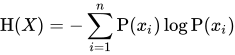
where  denotes the sum over the variable's possible values.
### Diehard tests
The diehard tests are a battery of statistical tests for measuring the quality of a random number generator. The diehard test suite conducted by TÜV Rheinland consisted of several individual tests like
* **Birthday spacings test**\
Choose random points on a large interval. The spacings between the points should be asymptotically exponentially distributed.
* **Overlapping 5-permutations test**\
Analyze sequences of five consecutive random numbers. The 120 possible orderings should occur with statistically equal probability.
* **Binary rank test for 31x31 matrices**\
Select some number of bits from some number of random numbers to form a matrix over {0,1}, then determine the rank of the matrix. Count the ranks.
* **Binary rank test for 32x32 matrices**
* **Binary rank test for 6x8 matrices**
* **Bitstream test**\
The test uses simulation to check if it is possible to interpret the integer output of a QRNG as a sequence of random bits.
* **OPSO, OQSO and DNA tests**
* **Count the 1's test**\
Count the 1 bits in each of either successive or chosen bytes. Convert the counts to "letters", and count the occurrences of five-letter "words".
* **Minimum distance test**\
Randomly place 8000 points in a 10000×10000 square, then find the minimum distance between the pairs. The square of this distance should be exponentially distributed with a certain mean.
* **3D spheres test**\
Randomly choose 4000 points in a cube of edge 1000. Center a sphere on each point, whose radius is the minimum distance to another point. The smallest sphere's volume should be exponentially distributed with a certain mean.
* **Squeeze test**\
Multiply 2^31 by random floats on (0,1) until you reach 1. Repeat this 100000 times. The number of floats needed to reach 1 should follow a certain distribution.
* **Overlapping sums test**\
Generate a long sequence of random floats on (0,1). Add sequences of 100 consecutive floats. The sums should be normally distributed with characteristic mean and variance.
* **Runs test**\
Generate a long sequence of random floats on (0,1). Count ascending and descending runs. The counts should follow a certain distribution.
* **Craps test**\
Play 200000 games of craps, counting the wins and the number of throws per game. Each count should follow a certain distribution.
### NIST tests
Ozone Chain's QRNG has also passed the NIST SP 800-22 tests, which is a test suite standards by National Institute of Standards and Technology. NIST SP 800-22 is a statistical test suite for random and pseudorandom number generators for cryptographic applications.
* **Frequency (monobit) test**
* **Frequency test within a block**
* **Runs test**
* **Longest run of ones in a block**
* **Binary matrix rank test**
* **Discrete Fourier Transform (Spectral) test**
* **Non-overlapping template matching test**
* **Overlapping template matching test**
* **Maurer's "Universal Statistical" test**
* **Linear complexity test**
* **Serial test**
* **Approximate entropy test**
* **Cumulative sums (Cusums) test**
* **Random excursions test**
* **Random excursions variant test**
# Conclusion
### Ozone Chain - A Future Ready Quantum Blockchain
Building resilience against future threats is key to ensure that vital parts of the blockchain and cryptocurrency economy keep thriving. The issue is that investments for protection from medium to long-term risks are somewhat natural to overlook or dismiss, given more pressing present issues, and the costs may not seem immediately justified. It often takes some bad incidents to incentivize the necessary proactive steps.
While blockchain technology prides itself in providing a trustless system upon which the economy of digital currencies and assets operate, the underlying security mechanisms still rely on classical cryptographical processes, thus necessitating a certain level of trust in them. Ozone Chain has assimilated quantum mechanical properties into its system, thus removing the trustful component of the security subsystem in blockchain, with ambitions of migrating towards of a truly trustless blockchain.
# References
1\. C. Guenther, The Relevance of Quantum Cryptography in Modern Cryptographic Systems, SANS Institute, 2004.
2\. Bagini, V., & Bucci, M. (2007). A design of reliable true random number generator for cryp- tographic applications.
3\. Crosby, Michael; Nachiappan; Pattanayak, Pradhan; Verma, Sanjeev; Kalyanaraman, Vignesh, "BlockChain Technology: Beyond Bitcoin" Berkeley, CA (2015)
4\. Kaliski, Burt, "The Mathematics of the RSA Public-Key Cyptosystem", RSA Laboratories.
5\. Dinh, Tien Tuan Anh; Wang, Ji; Chen, Gang; Liu, Rui; Ooi, Beng Chin; Tan, Kian-Lee (2017). "Blockbench: A Framework for Analyzing Private blockchains,"
6\. Gas and Transactions in Ethereum transactions/account-types-gas-and- transactions.html
 , which takes values in the alphabet  and is distributed according to ![{\displaystyle p:{\mathcal {X}}\to \[0,1\]}](https://wikimedia.org/api/rest_v1/media/math/render/svg/f219961c04ea0285eff7416f743c7684e0da25fa)

where  denotes the sum over the variable's possible values.
### Diehard tests
The diehard tests are a battery of statistical tests for measuring the quality of a random number generator. The diehard test suite conducted by TÜV Rheinland consisted of several individual tests like
* **Birthday spacings test**\
Choose random points on a large interval. The spacings between the points should be asymptotically exponentially distributed.
* **Overlapping 5-permutations test**\
Analyze sequences of five consecutive random numbers. The 120 possible orderings should occur with statistically equal probability.
* **Binary rank test for 31x31 matrices**\
Select some number of bits from some number of random numbers to form a matrix over {0,1}, then determine the rank of the matrix. Count the ranks.
* **Binary rank test for 32x32 matrices**
* **Binary rank test for 6x8 matrices**
* **Bitstream test**\
The test uses simulation to check if it is possible to interpret the integer output of a QRNG as a sequence of random bits.
* **OPSO, OQSO and DNA tests**
* **Count the 1's test**\
Count the 1 bits in each of either successive or chosen bytes. Convert the counts to "letters", and count the occurrences of five-letter "words".
* **Minimum distance test**\
Randomly place 8000 points in a 10000×10000 square, then find the minimum distance between the pairs. The square of this distance should be exponentially distributed with a certain mean.
* **3D spheres test**\
Randomly choose 4000 points in a cube of edge 1000. Center a sphere on each point, whose radius is the minimum distance to another point. The smallest sphere's volume should be exponentially distributed with a certain mean.
* **Squeeze test**\
Multiply 2^31 by random floats on (0,1) until you reach 1. Repeat this 100000 times. The number of floats needed to reach 1 should follow a certain distribution.
* **Overlapping sums test**\
Generate a long sequence of random floats on (0,1). Add sequences of 100 consecutive floats. The sums should be normally distributed with characteristic mean and variance.
* **Runs test**\
Generate a long sequence of random floats on (0,1). Count ascending and descending runs. The counts should follow a certain distribution.
* **Craps test**\
Play 200000 games of craps, counting the wins and the number of throws per game. Each count should follow a certain distribution.
### NIST tests
Ozone Chain's QRNG has also passed the NIST SP 800-22 tests, which is a test suite standards by National Institute of Standards and Technology. NIST SP 800-22 is a statistical test suite for random and pseudorandom number generators for cryptographic applications.
* **Frequency (monobit) test**
* **Frequency test within a block**
* **Runs test**
* **Longest run of ones in a block**
* **Binary matrix rank test**
* **Discrete Fourier Transform (Spectral) test**
* **Non-overlapping template matching test**
* **Overlapping template matching test**
* **Maurer's "Universal Statistical" test**
* **Linear complexity test**
* **Serial test**
* **Approximate entropy test**
* **Cumulative sums (Cusums) test**
* **Random excursions test**
* **Random excursions variant test**
# Conclusion
### Ozone Chain - A Future Ready Quantum Blockchain
Building resilience against future threats is key to ensure that vital parts of the blockchain and cryptocurrency economy keep thriving. The issue is that investments for protection from medium to long-term risks are somewhat natural to overlook or dismiss, given more pressing present issues, and the costs may not seem immediately justified. It often takes some bad incidents to incentivize the necessary proactive steps.
While blockchain technology prides itself in providing a trustless system upon which the economy of digital currencies and assets operate, the underlying security mechanisms still rely on classical cryptographical processes, thus necessitating a certain level of trust in them. Ozone Chain has assimilated quantum mechanical properties into its system, thus removing the trustful component of the security subsystem in blockchain, with ambitions of migrating towards of a truly trustless blockchain.
# References
1\. C. Guenther, The Relevance of Quantum Cryptography in Modern Cryptographic Systems, SANS Institute, 2004.
2\. Bagini, V., & Bucci, M. (2007). A design of reliable true random number generator for cryp- tographic applications.
3\. Crosby, Michael; Nachiappan; Pattanayak, Pradhan; Verma, Sanjeev; Kalyanaraman, Vignesh, "BlockChain Technology: Beyond Bitcoin" Berkeley, CA (2015)
4\. Kaliski, Burt, "The Mathematics of the RSA Public-Key Cyptosystem", RSA Laboratories.
5\. Dinh, Tien Tuan Anh; Wang, Ji; Chen, Gang; Liu, Rui; Ooi, Beng Chin; Tan, Kian-Lee (2017). "Blockbench: A Framework for Analyzing Private blockchains,"
, which takes values in the alphabet  and is distributed according to ![{\displaystyle p:{\mathcal {X}}\to \[0,1\]}](https://wikimedia.org/api/rest_v1/media/math/render/svg/f219961c04ea0285eff7416f743c7684e0da25fa)

where  denotes the sum over the variable's possible values.
### Diehard tests
The diehard tests are a battery of statistical tests for measuring the quality of a random number generator. The diehard test suite conducted by TÜV Rheinland consisted of several individual tests like
* **Birthday spacings test**\
Choose random points on a large interval. The spacings between the points should be asymptotically exponentially distributed.
* **Overlapping 5-permutations test**\
Analyze sequences of five consecutive random numbers. The 120 possible orderings should occur with statistically equal probability.
* **Binary rank test for 31x31 matrices**\
Select some number of bits from some number of random numbers to form a matrix over {0,1}, then determine the rank of the matrix. Count the ranks.
* **Binary rank test for 32x32 matrices**
* **Binary rank test for 6x8 matrices**
* **Bitstream test**\
The test uses simulation to check if it is possible to interpret the integer output of a QRNG as a sequence of random bits.
* **OPSO, OQSO and DNA tests**
* **Count the 1's test**\
Count the 1 bits in each of either successive or chosen bytes. Convert the counts to "letters", and count the occurrences of five-letter "words".
* **Minimum distance test**\
Randomly place 8000 points in a 10000×10000 square, then find the minimum distance between the pairs. The square of this distance should be exponentially distributed with a certain mean.
* **3D spheres test**\
Randomly choose 4000 points in a cube of edge 1000. Center a sphere on each point, whose radius is the minimum distance to another point. The smallest sphere's volume should be exponentially distributed with a certain mean.
* **Squeeze test**\
Multiply 2^31 by random floats on (0,1) until you reach 1. Repeat this 100000 times. The number of floats needed to reach 1 should follow a certain distribution.
* **Overlapping sums test**\
Generate a long sequence of random floats on (0,1). Add sequences of 100 consecutive floats. The sums should be normally distributed with characteristic mean and variance.
* **Runs test**\
Generate a long sequence of random floats on (0,1). Count ascending and descending runs. The counts should follow a certain distribution.
* **Craps test**\
Play 200000 games of craps, counting the wins and the number of throws per game. Each count should follow a certain distribution.
### NIST tests
Ozone Chain's QRNG has also passed the NIST SP 800-22 tests, which is a test suite standards by National Institute of Standards and Technology. NIST SP 800-22 is a statistical test suite for random and pseudorandom number generators for cryptographic applications.
* **Frequency (monobit) test**
* **Frequency test within a block**
* **Runs test**
* **Longest run of ones in a block**
* **Binary matrix rank test**
* **Discrete Fourier Transform (Spectral) test**
* **Non-overlapping template matching test**
* **Overlapping template matching test**
* **Maurer's "Universal Statistical" test**
* **Linear complexity test**
* **Serial test**
* **Approximate entropy test**
* **Cumulative sums (Cusums) test**
* **Random excursions test**
* **Random excursions variant test**
# Conclusion
### Ozone Chain - A Future Ready Quantum Blockchain
Building resilience against future threats is key to ensure that vital parts of the blockchain and cryptocurrency economy keep thriving. The issue is that investments for protection from medium to long-term risks are somewhat natural to overlook or dismiss, given more pressing present issues, and the costs may not seem immediately justified. It often takes some bad incidents to incentivize the necessary proactive steps.
While blockchain technology prides itself in providing a trustless system upon which the economy of digital currencies and assets operate, the underlying security mechanisms still rely on classical cryptographical processes, thus necessitating a certain level of trust in them. Ozone Chain has assimilated quantum mechanical properties into its system, thus removing the trustful component of the security subsystem in blockchain, with ambitions of migrating towards of a truly trustless blockchain.
# References
1\. C. Guenther, The Relevance of Quantum Cryptography in Modern Cryptographic Systems, SANS Institute, 2004.
2\. Bagini, V., & Bucci, M. (2007). A design of reliable true random number generator for cryp- tographic applications.
3\. Crosby, Michael; Nachiappan; Pattanayak, Pradhan; Verma, Sanjeev; Kalyanaraman, Vignesh, "BlockChain Technology: Beyond Bitcoin" Berkeley, CA (2015)
4\. Kaliski, Burt, "The Mathematics of the RSA Public-Key Cyptosystem", RSA Laboratories.
5\. Dinh, Tien Tuan Anh; Wang, Ji; Chen, Gang; Liu, Rui; Ooi, Beng Chin; Tan, Kian-Lee (2017). "Blockbench: A Framework for Analyzing Private blockchains,"